
Local Adult Education Explained: Pathways to Growth
Explore local adult education: types, benefits, entry requirements, legal protections, risks, costs, and choosing the right Waterlooville program.
Local Adult Education Explained: Pathways to Growth

Many adults in Waterlooville reach a point where updating skills or earning new qualifications feels not just helpful but necessary for career growth or personal satisfaction. Local adult education programs offer more than lessons—they provide real opportunities to improve literacy, math, technology, and workplace skills in settings that fit your life. Whether you need a flexible class schedule or want to connect with other learners pursuing similar goals, these programs focus on practical skill-building and community support so you can move confidently toward your next step.
Table of Contents
- Defining Local Adult Education Programs
- Types and Formats of Adult Learning Opportunities
- Key Entry Requirements and Eligibility
- Legal Protections and Learner Rights
- Financial Costs and Funding Options
- Mistakes to Avoid When Choosing Courses
Key Takeaways
| Point | Details |
|---|---|
| Focus on Practical Skills | Local adult education programs aim to equip adults with essential skills tailored to their individual goals, enhancing employability and community engagement. |
| Flexible Learning Formats | Adult education offers various formats, including online, hybrid, and traditional classes, allowing learners to choose options that fit their schedules and learning preferences. |
| Inclusivity in Eligibility Criteria | Most programs in Waterlooville welcome participants aged 16 and older, emphasizing accessibility for individuals at various skill and education levels. |
| Financial Support is Available | Many programs are publicly funded or offer sliding scale fees, making education more affordable and accessible for adults seeking to improve their skills. |
Defining Local Adult Education Programs
Local adult education programs are structured learning opportunities designed specifically for adults who want to improve their skills, advance their careers, or strengthen their capabilities as workers, family members, and engaged citizens. These programs aren’t just about sitting in a classroom and absorbing information. They represent real pathways to tangible outcomes. In Waterlooville, like communities across the country, adult education exists to serve adults who may have missed traditional schooling opportunities or need to update skills for today’s job market.
At their core, local adult education programs focus on helping adults acquire practical skills including reading, writing, mathematics, English language proficiency, and problem-solving abilities. The structure typically involves partnerships between state education providers and local organizations, all working within federally established guidelines to ensure quality and real accessibility. This isn’t about one-size-fits-all education. Programs adapt to local needs. If you’re working in Waterlooville and need to improve your English skills for a promotion, you’ll find different support than someone seeking basic math competency for a career shift. The variety matters because adult learners have different starting points and different goals.
What makes local programs distinct from traditional education is their focus on real-world application and community connection. Communal learning spaces in adult education emphasize collective knowledge-building where adults support each other’s growth. These settings often address broader social and economic issues affecting the community. You’re not just learning in isolation. You’re part of a group working toward shared improvement. Local programs recognize that adults learn differently than young students. Adult learners bring work experience, life challenges, and specific motivations. Programs in your area connect these adult learners with peers facing similar situations, creating an environment where mutual support drives progress.
Local adult education typically includes these core elements:
- Basic skills training in literacy, numeracy, and English language learning
- Workforce development programs aligned with local job market demands
- Digital literacy and technology skills training
- GED preparation and high school equivalency programs
- Career counseling and job placement support
- Flexible scheduling to accommodate working adults
- Childcare support or evening classes for those with family responsibilities
The programs available in and around Waterlooville are designed with your specific situation in mind. Whether you’re looking to transition careers, improve job prospects, or build confidence in specific skill areas, these local offerings connect you directly with resources and instructors who understand the local employment landscape and community needs.
Pro tip: Start by identifying which specific skill gap is holding you back from your next career move, then contact local providers to see which program addresses that exact need rather than picking a general course option.
Types and Formats of Adult Learning Opportunities
Adult learning doesn’t follow a single path. You have choices. Real options tailored to how you work, when you have availability, and what matters to your specific situation. Understanding the different types and formats available helps you pick what actually fits your life rather than forcing yourself into an inflexible schedule. Adult learning falls into three distinct categories, each serving different purposes and learning styles.
Formal learning includes structured education programs that lead to recognized qualifications. Think GED completion, professional certifications, or degree programs offered through colleges and universities. These programs have set curricula, formal assessments, and official credentials at the end. In Waterlooville, formal adult education programs might include accredited vocational courses or college-level classes. Non-formal learning sits between formal and informal. These are organized educational activities outside the traditional school system, like workshop series, professional development seminars, or skills training programs offered by local organizations. They’re structured and planned but typically shorter and more flexible than formal education. Informal learning happens through daily activities and experience. You learn a new software tool from a coworker, pick up communication skills from leading a community project, or develop problem-solving abilities through work challenges. This type doesn’t come with credentials, but it’s real learning that builds your capabilities.
Adult learning encompasses formal, non-formal, and informal activities that adults undertake to update knowledge and skills. The formats available vary widely depending on what you need and how you prefer to learn. Traditional classroom instruction remains popular, offering face-to-face interaction with instructors and peers. Online and hybrid formats have expanded dramatically, allowing you to study from home while maintaining work schedules. Microlearning modules break content into short, focused lessons you can complete during breaks. Evening classes accommodate people who work during the day. Weekend intensives work for those juggling multiple responsibilities. Some programs offer self-paced options where you progress through material on your own timeline.
Here is a comparison of the main adult learning types and when each is most useful:
| Learning Type | Key Benefit | Typical Outcome | Best For |
|---|---|---|---|
| Formal | Recognized credentials | Degrees, certifications | Career changes, job mandates |
| Non-formal | Focused, practical skills | Skill certificates, growth | Fast upskilling, flexibility |
| Informal | Experiential knowledge | Personal development | Self-motivation, exploration |
Common Learning Formats in Waterlooville
- Evening and weekend classes: Perfect if you’re employed full-time and can only study outside work hours
- Online and distance learning: Complete flexibility to study when and where it suits you, often from your home
- Hybrid programs: Combine online components with occasional in-person sessions for hands-on practice
- Intensive short courses: Concentrated learning over days or weeks rather than spread across months
- One-to-one tutoring: Personalized instruction targeting your specific skill gaps
- Group workshops: Focused sessions on particular skills or topics with peer interaction
- Apprenticeships and on-the-job training: Learning directly within a work environment
Flexible learning formats such as micro-credentials and short modules allow adults to balance education with other responsibilities. This flexibility matters tremendously because most adults juggling work, family, and personal obligations can’t commit to rigid schedules. A parent working full-time needs different options than a retiree looking to develop new skills. Someone in a demanding job role might prefer focused weekend workshops over a semester-long commitment. The variety of formats available means you’re not choosing between education and your other responsibilities. You’re finding an option that lets you do both.
The type and format you choose depends on your goals, timeline, and circumstances. If you need a recognized qualification for career advancement, formal programs with credentials matter. If you want to build specific job skills quickly, non-formal training through workshops or short courses works well. If you’re exploring interests or developing general capabilities, informal learning through community programs or self-directed study builds confidence. In Waterlooville, consider what outcome you actually need. A promotion that requires certification demands formal learning. Staying current in your field might benefit from regular non-formal workshops. Building confidence in a new area could start with informal community learning. The programs available locally support all these pathways.
Pro tip: List your learning goal, time availability, and preferred learning style, then match that to the format options available rather than enrolling in whatever program starts first.
Key Entry Requirements and Eligibility
Before enrolling in an adult education program, you need to understand who can actually participate and what basic criteria apply. The good news is that eligibility is designed to be inclusive rather than restrictive. Most adults in Waterlooville who want to improve their skills can access these programs. The requirements exist to ensure programs serve those who need them most and to allocate resources effectively. Age matters as a baseline, but it’s not the only factor. Your skill level, residency status, and learning goals all play a role in determining which programs you can join.

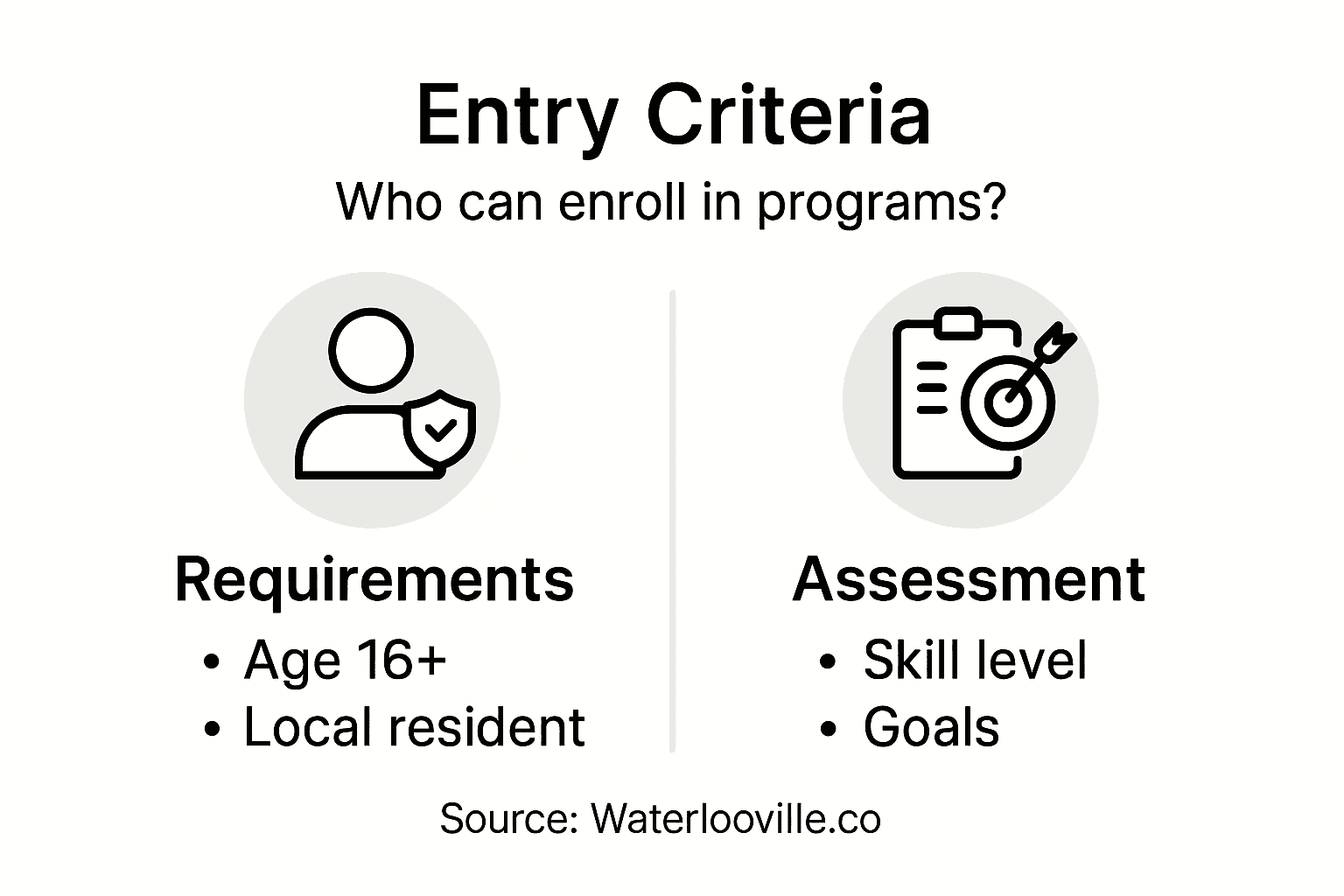
Participation in adult education programs is generally limited to ages 16 and older, though most programs specifically serve adults aged 18 and above. If you’re out of school and past typical high school age, you’ll qualify for most offerings in Waterlooville. Beyond age, eligibility typically focuses on your skill levels and what you need to learn. If your reading or writing abilities fall below a certain level, you qualify for literacy programs. If your English proficiency needs improvement, English language programs exist for you. If you lack a high school diploma or GED, secondary education equivalency programs accept you. These programs aren’t designed for people who already have advanced skills. They’re built for people at specific skill levels who need to catch up or learn new competencies.
Residency requirements vary by program but often require you to live in the service area or be employed locally. Waterlooville and surrounding areas like Cowplain, Denmead, and Purbrook typically have programs with flexible residency policies. When you contact a local provider, ask directly about residency. Some programs prioritize local residents, while others accept anyone who can attend regularly. Your ability to commit to attendance and engagement matters more than your exact zip code. Programs track completion rates because they’re funded through public resources, so providers want students who will actually show up and participate rather than enroll casually.
Common Eligibility Criteria
These factors typically determine whether you can enter a specific program:
- Age requirement: Usually 16 or older, more commonly 18 and above
- Skill level assessment: Your current literacy, numeracy, or language proficiency must fall within the program’s target range
- Learning goal alignment: Your reason for enrollment matches what the program offers
- Residency or employment: You live or work in the service area
- Commitment to attendance: You demonstrate ability to attend sessions regularly
- Educational background: You may lack certain qualifications the program addresses
Entry requirements focus on skill levels and preparing learners for further education or employment. Most programs assess your current abilities before enrollment. This isn’t a judgment. It’s practical. If you’re learning English as a second language, you’ll be placed in classes with others at your level, not with native speakers. If you’re brushing up on math skills, you’ll start at the right level for your current knowledge. This placement system means you won’t waste time in classes that are too basic or too advanced.
One common misconception is that you need perfect qualifications to enroll. The opposite is true. Programs exist because you don’t have those qualifications yet. You don’t need a previous degree to join a GED program. You don’t need basic computer skills to join digital literacy training. You don’t need perfect English to join an English language program. The whole point is that these programs accept you at your current level and help you progress. Some programs do require you to demonstrate basic motivation, like showing up to an initial assessment or expressing your learning goals clearly. This helps programs match you with the right courses and instructors.
Getting started is straightforward. Contact local education providers and ask about eligibility for programs matching your interests. They’ll likely ask about your age, current skill level, and what you hope to achieve. Many programs offer free initial assessments where advisors help identify the right fit. You’re not committing to anything at this stage. You’re getting information about whether the program suits your situation and what you can expect. Bring any existing qualifications or certificates you have, as these help advisors understand your background. Be honest about your current abilities. Overstating your skills leads to frustrating class experiences. Understating them wastes your time in classes too basic for your level.
Pro tip: Contact multiple local providers and ask specifically about their enrollment process and assessment procedures before applying, so you understand exactly what each program expects and can prepare any needed documentation.
Legal Protections and Learner Rights
When you enroll in an adult education program, you’re not just a student. You’re a person with legal rights and protections built into the system. These protections exist at federal and state levels, designed to ensure you receive fair treatment, quality education, and privacy safeguards. Understanding your rights helps you advocate for yourself if problems arise and gives you confidence that programs must operate to certain standards. Adult education isn’t an unregulated space where anything goes. There are real laws governing how programs operate and how they must treat learners like you.
Adult education laws like the Workforce Innovation and Opportunity Act (WIOA) protect learner rights by ensuring equal access, preventing discrimination, and holding providers accountable. These federal frameworks establish that education providers must treat all learners fairly regardless of race, color, national origin, sex, disability, or other protected characteristics. If a program denies you access because of who you are or where you’re from, that violates federal law. Programs receive federal funding with conditions attached. One major condition is that they serve learners equitably and without discrimination. Providers know this. They have compliance officers and policies specifically designed to follow these requirements.
Privacy protections matter significantly when you’re a student. Your educational records, personal information, and learning progress belong to you. Programs cannot share your grades, attendance, or test scores with employers or other third parties without your permission. If you’re concerned about privacy, you can ask programs directly about their data protection policies. How do they store your information? Who has access to it? How long do they keep it? These aren’t difficult questions to ask, and legitimate programs answer them clearly. Your personal data, health information, and family situations discussed with instructors or counselors receive legal protection under various privacy laws. If you disclose that you’re struggling with childcare, that information cannot be used against you in hiring decisions or shared publicly.
Your Core Learner Rights
These protections apply to you as an adult learner in programs across the United States:
- Equal access: Programs cannot deny you entry based on race, ethnicity, gender, disability, age, or national origin
- Quality education: Programs funded publicly must meet established standards and provide qualified instructors
- Privacy protection: Your personal and educational information stays confidential without your consent
- Accessibility accommodations: If you have disabilities, programs must provide reasonable accommodations to enable your participation
- Non-discrimination: Providers cannot treat you unfairly based on protected characteristics
- Complaint procedures: You have the right to file complaints if your rights are violated
- Transparent policies: Programs must clearly communicate their policies and procedures
Adult education is recognized internationally as a fundamental human right supporting lifelong learning. This isn’t just a nice idea. It’s embedded in international law and supported by governments worldwide. The principle recognizes that education isn’t just for children. Adults have inherent rights to access learning opportunities that help them develop personally and participate fully in society. This framing matters because it positions adult education not as charity or optional but as something you’re entitled to access.
Disability accommodations deserve specific attention because they affect many learners. If you’re deaf and need an interpreter, programs must provide one. If you’re blind and need materials in large print or audio format, they must arrange that. If you have learning disabilities and benefit from extended test time, that’s a reasonable accommodation. Programs cannot charge you extra for these accommodations or use them as reasons to deny your participation. The same principle applies to childcare support, transportation assistance, or scheduling flexibility for people with caregiving responsibilities. These accommodations ensure genuine access, not just theoretical eligibility.
If you experience discrimination or your rights are violated, you have recourse options. Most programs have internal complaint procedures. Start by reporting the issue to program leadership. Document what happened, when, who was involved, and how it affected you. Keep copies of everything. If internal resolution fails, you can file complaints with state or federal education agencies. The U.S. Department of Education’s Office for Civil Rights investigates discrimination complaints. Your state education department also handles grievances. These processes exist because your rights matter and laws back them up.
Your feedback also shapes programs. Many adult education providers actively seek learner input about what’s working and what could improve. Attending advisory meetings, completing surveys, or speaking with program directors about your experience contributes to quality. Providers use this feedback to adjust schedules, improve instruction, or add services. Your voice as a learner carries weight in how programs develop.
Pro tip: Before enrolling, ask each program to explain its non-discrimination policy, accessibility accommodations process, and complaint procedures in writing so you know exactly what protections apply and how to access them if needed.
Financial Costs and Funding Options
Cost is often the first barrier adults consider when thinking about education. Will it drain your savings? Will you need to take out loans? The reality in Waterlooville and across the United States is more encouraging than you might expect. Many adult education programs are partially or fully funded through public resources, meaning your costs are significantly lower than traditional college education. Some programs are completely free. Understanding your financial options helps you make realistic decisions about which programs fit your budget and circumstances.
Public funding for adult education comes from federal, state, and local sources specifically allocated to support learners who need skill development. The Workforce Innovation and Opportunity Act (WIOA) funds many programs through state workforce systems. The Adult Education and Family Literacy Act (AEFLA) supports basic skills programs. Individual states also allocate funding for adult education through general education budgets. Local community colleges receive public funding that supports affordable adult learner programs. This means many programs cost nothing upfront or charge only modest fees. When programs do charge fees, they’re typically subsidized, making them far cheaper than private education providers. A semester-long community college course might cost $200 to $500, compared to thousands at private institutions.
Adult education funding in the United Kingdom supports learners through eligibility criteria including residency and income thresholds. Similar approaches exist in the United States where funding mechanisms target adults with greatest need. Income-based support means if you’re earning below certain thresholds, you may qualify for fully covered tuition. Even if you don’t qualify for full funding, many programs offer sliding scale fees based on what you actually earn. This approach recognizes that struggling adults shouldn’t be priced out of education designed to help them improve their situations. Programs know that charging someone $50 per week might prevent their attendance despite motivation. Sliding scales solve this.
Common Funding and Cost Scenarios
Here’s what you might encounter financially:
- Fully funded programs: No tuition costs, often including materials and supplies
- Sliding scale fees: You pay based on your income level, possibly nothing if very low income
- Modest fixed fees: Standard charges of $50 to $200 per program or term
- Employer sponsorship: Your employer pays for job-related training you need
- Workforce grants: WIOA funding covers eligible adults’ full program costs
- Scholarships and financial aid: Specific programs offer awards for qualified applicants
- Payment plans: Monthly installments instead of lump sum costs
When you contact programs in Waterlooville, ask directly about costs and whether you might qualify for fee waivers or reduced rates. Many adults don’t ask because they’re embarrassed about financial constraints. Programs expect these questions. They have processes for determining eligibility and can often help immediately. Some programs conduct quick income verifications on the spot. Others accept simple documentation of your current employment or benefit status. The point is they’re set up to help people access education affordably, not to screen out those with limited resources.
Beyond tuition, consider secondary costs that affect your actual spending. Textbooks and materials may or may not be included in program fees. Some programs provide everything free. Others require you to purchase books or supplies. Ask about this specifically. Do they provide computers for computer skills training or do you need your own? Do they supply childcare so you can attend evening classes, or do you need to arrange it? These details matter financially. A program advertised as free but requiring $100 in book purchases and childcare costs effectively costs more than a program charging $150 upfront that includes everything.
Employer sponsorship presents another financial option. If you’re employed, ask whether your employer offers tuition reimbursement or covers professional development costs. Many employers fund training that improves job skills. If your role requires new certifications, your company might pay entirely. Even if employers don’t formally sponsor programs, some offer flexible schedules or paid time off for learning, reducing the opportunity cost of attending classes.
Federal programs like WIOA provide more than just tuition funding. Eligible participants receive support services including childcare assistance, transportation help, and sometimes stipends while training. If you’re unemployed or significantly underemployed, investigate whether you qualify for WIOA programs in your area. These are specifically designed to support people retraining for better employment.
One critical point: never avoid a program because initial cost seems high without asking about assistance. Programs consistently have more funding flexibility than advertised. Fee waivers exist. Payment plans exist. Work-study arrangements exist. Income-based reductions exist. If cost is your only concern preventing enrollment, contact the program and explain your situation. They often find solutions.
Here is a summary of common costs and funding options for adult education programs:
| Cost/Funding Source | Average Out-of-Pocket Cost | Key Eligibility Factor | When to Consider |
|---|---|---|---|
| Publicly funded | $0 | Low income, residency | First option, budget limits |
| Sliding scale fee | $25–$200 | Income-based | Moderate income, partial aid |
| Employer sponsorship | $0 | Job relevance, approval | Job advancement, new skills |
| Scholarship/grants | $0–$100 | Performance, need | High achievers, special cases |
Pro tip: Before enrolling anywhere, ask three specific questions: What are the total costs, what funding or fee reduction programs do you offer, and what secondary costs like books or supplies should I budget for? Get answers in writing so you know the true financial commitment.
Mistakes to Avoid When Choosing Courses
Choosing the wrong course wastes time, money, and motivation. You might invest weeks in a program that doesn’t match your goals, your schedule, or your learning style. You might discover too late that the credential you’re earning doesn’t actually help your career. You might find yourself in a class far too advanced or disappointingly basic for your current abilities. These mistakes are preventable. Understanding common pitfalls helps you make decisions that actually serve your situation rather than derailing your progress. Adult learners often rush course selection because they’re eager to start or because they see a program starting soon. Slow down. A few days of research now prevents months of regret later.
One of the biggest mistakes adults make is choosing courses based on what seems convenient rather than what actually matters for their goals. A program starting next week sounds appealing, but if it doesn’t address your real needs, convenience becomes a waste. Before enrolling anywhere, write down your specific goal. Are you seeking a credential for a job promotion? Developing skills for a career change? Building confidence in a specific area? Learning something new for personal fulfillment? These different goals lead to different course choices. If your employer requires a specific certification for advancement, only that certification matters. A generic business course won’t help, no matter how well reviewed it is. Common mistakes when choosing educational programs include not understanding personal interests and making decisions too quickly without thorough research. Rush decisions often lead to misalignment between your actual needs and what a course delivers.
Another critical error is ignoring course accreditation and instructor credentials. Not all adult education programs carry equal weight. Some offer recognized qualifications that employers value. Others provide valuable learning but no official credential. Some instructors are highly experienced professionals. Others are well-meaning volunteers without subject matter expertise. Ask directly about instructor qualifications. How many years have they worked in this field? Do they hold relevant certifications? Are they currently working in the industry or retired from it? For accreditation, ask whether the course credential is recognized by employers in your target field. A well-reviewed course taught by someone unqualified or offering an unrecognized certificate might feel productive while actually delivering little value for your goals. Choosing the right course requires evaluating accreditation and assessing instructor expertise to ensure the investment aligns with your objectives.
Critical Mistakes to Avoid
These are the decisions that most often lead to regret:
- Enrolling without clarifying your goal: Jumping into a course because it sounds interesting or starts soon, without connecting it to what you actually need
- Ignoring time commitments: Underestimating how many hours a week the course demands and enrolling despite conflicting responsibilities
- Skipping accreditation checks: Assuming a well-reviewed course carries recognized credentials without verifying
- Not researching instructor backgrounds: Enrolling without knowing whether instructors have real-world expertise in what they’re teaching
- Choosing based on peer pressure: Following friends into a program that doesn’t match your situation or goals
- Overlooking learning format mismatches: Selecting online when you need face-to-face interaction or vice versa
- Underestimating total costs: Only looking at tuition while ignoring books, materials, childcare, or transportation expenses
- Starting before assessing prerequisites: Enrolling in intermediate courses when you lack foundational knowledge needed to succeed
Misunderstanding time commitment represents a massive mistake. Adults often think a course requiring 6 hours per week fits their schedule, then discover they can’t sustain that alongside work and family. Ask programs directly: How many hours per week do successful students spend? Is that classroom time plus homework or total time? Are there deadlines that don’t flex? Can you miss weeks and catch up or does everything happen live? Be honest with yourself about what you can actually manage. A course you complete at 5 hours weekly matters more than an intensive program you abandon after three weeks.
Peer pressure and social influence affect adult learners too. A friend raves about their certification program and enrolls you out of excitement. Your coworker suggests you take the same class they’re taking. Social connection matters, but not if the program doesn’t serve your actual goals. Your friend’s perfect course might be wrong for you. Their schedule works for them but not for you. Their career path differs from yours. Make independent decisions based on your situation, not on what works for someone else.
Another frequent error is choosing courses that sound impressive but offer limited practical value. A course titled “Leadership Excellence” sounds better than “Practical Team Communication Skills,” but the second might teach you more applicable content. Similarly, prestigious-sounding programs sometimes cost far more without delivering proportionally better outcomes. The program’s reputation matters less than whether it teaches what you need in a format you can handle.
Don’t skip the basics either. Before enrolling in any course, contact the program and ask to speak with current students or recent graduates. What did they like and dislike? Did the course deliver what was promised? Did the instructor keep you engaged? Would they recommend it? Speaking with actual learners beats reading polished marketing copy. Programs confident in their quality encourage these conversations.
Pro tip: Create a simple checklist before enrolling: Does this align with my specific goal, can I commit the required hours weekly, is the instructor qualified, is any credential recognized by my target employers, and what’s the total cost including hidden expenses? Don’t enroll until every answer satisfies you.
Unlock Your Potential with Local Adult Education Resources in Waterlooville
The article highlights real challenges adults face when seeking education that fits their busy lives and goals like career advancement, skill development, and community engagement. Many adults struggle with finding flexible learning formats that accommodate work and family, understanding eligibility requirements, and accessing affordable, high-quality programs that offer recognized credentials. These pain points demand a trustworthy, local resource to help navigate education options effectively and confidently.
At Waterlooville.co, you can explore a community-focused guide that connects you with essential local services and education providers tailored to your needs. Whether you’re looking for flexible classes, childcare support, or specific skill training programs, our site offers up-to-date information about educational opportunities and related community resources in Waterlooville and nearby areas like Cowplain and Denmead.

Take charge of your learning journey today through Waterlooville.co. Find local programs that match your goals and schedule with ease. Visit local resources to discover education providers, community support options, and service professionals who understand your unique challenges. Don’t wait to build the skills and confidence that can transform your future. Start now and unlock the pathways to growth right here in Waterlooville.
Frequently Asked Questions
What are local adult education programs?
Local adult education programs are structured learning opportunities designed for adults aiming to improve skills, advance careers, or enhance their roles in the community. They focus on practical skills such as literacy, numeracy, and English language proficiency.
How do I find the right adult education program for my needs?
Start by identifying your specific goals, such as acquiring a credential, learning new skills, or personal development. Contact local education providers to discover which programs align with your needs and learning style.
What types of learning formats are available for adult education?
Adult education offers various formats including formal courses leading to certifications, non-formal workshops for skill development, and informal learning opportunities through community engagement. Online, hybrid, and self-paced options are available to suit different schedules and preferences.
Are adult education programs affordable, and what funding options exist?
Many adult education programs are subsidized or fully funded through public resources, meaning costs can be low or even free. Funding options may include sliding scale fees based on income, employer sponsorships, and grants designed to support eligible learners.