
Why Monitor Online Reviews: Impact on Local Business Reputation
Discover why monitoring online reviews is crucial for Waterlooville businesses: influence on customer trust, SEO, reputation, and handling negative feedback.
Why Monitor Online Reviews: Impact on Local Business Reputation

Every business owner in Waterlooville has felt that moment of uncertainty when a new review pops up online. What customers say on platforms like Google My Business and Trustpilot shapes how people in Waterlooville, Cowplain, and Purbrook view your reputation before they ever call or visit. Active review monitoring empowers you to catch feedback quickly, respond professionally, and build trust that leads to more customer inquiries. Discover why understanding myths, credibility factors, and the impact of reviews can keep your business thriving in a competitive local market.
Table of Contents
- Online Reviews Defined And Common Myths
- Types Of Review Platforms And Key Differences
- Google My Business And Search Visibility
- Trustpilot, TripAdvisor, And Niche Platforms
- Social Media As Review Channels
- How Reviews Influence Customer Trust And SEO
- The Trust Factor
- The SEO Connection
- Benefits Of Active Review Monitoring For Businesses
- Catching Problems Before They Spread
- Building Stronger Customer Relationships
- Competitive Advantage
- Risks Of Neglecting Online Reputation Management
- Lost Customer Acquisition And Revenue Impact
- Crisis Vulnerability And Trust Erosion
- The Compounding Effect
Key Takeaways
| Point | Details |
|---|---|
| Online Reviews Matter | Online reviews significantly influence customer perceptions and can directly impact business reputation and search rankings. |
| Active Monitoring is Essential | Regularly monitoring and responding to reviews can enhance customer relationships and address potential issues before they escalate. |
| Credibility Factors Vary | Not all reviews are equal; verified, detailed feedback from engaged customers carries more weight than generic ratings. |
| Neglecting Reputation Risks Revenue | Ignoring online reviews can lead to lost customers and damage trust, making active reputation management crucial for long-term success. |
Online Reviews Defined and Common Myths
Online reviews are customer opinions, ratings, and comments posted on public platforms, review sites, and social media about businesses, products, or services. For your hair salon on Winchester Road, your local restaurant near the town center, or your heating engineer serving Waterlooville and surrounding areas like Cowplain and Purbrook, these reviews function as digital word-of-mouth recommendations. Unlike traditional recommendations shared over coffee at a local cafe, online reviews reach hundreds or thousands of potential customers instantly. They exist on dedicated platforms like Google My Business, Trustpilot, and industry-specific review sites, as well as on general social media channels where customers naturally discuss their experiences. The key characteristic that separates a genuine review from noise is that it typically includes specific details about the customer’s actual experience, though this is not always reliable.
One of the biggest misconceptions about online reviews is that all feedback is created equal. Not true. Credibility factors in reviews vary significantly based on whether the reviewer is verified as an actual customer, whether they’ve left multiple reviews across time, and whether their account appears legitimate. A five-star review from someone with one review and no profile history carries far less weight than a detailed three-star review from a customer with a demonstrated history on the platform. This matters because customers scrolling through your business listing in Waterlooville are savvy enough to spot fake reviews, yet many business owners still believe any positive review helps equally. The reality is that obvious fake reviews can damage your credibility faster than a genuine negative review ever could.
Another widespread myth is that online reviews are primarily about complaining. In fact, satisfied customers do leave reviews, though not always in the same volume as dissatisfied ones. The psychology of human behavior means people tend to share extreme experiences, positive or negative. A customer who received mediocre service at your Waterlooville business might feel indifferent enough to skip leaving a review entirely. But that same customer will absolutely post if their experience was exceptional or if something went seriously wrong. This creates what appears to be a negative bias in review platforms, when really it’s just a reflection of what motivates people to take the extra step of leaving feedback. Additionally, many business owners wrongly assume that reviews are always factual. In reality, reviews can contain misleading information that significantly influences consumer perception, even when that information is inaccurate or intentionally distorted. Understanding this distinction between perception and reality is essential for managing your reputation effectively.
Here’s something else worth clarifying: reviews are not just ratings. The star count matters far less than what people actually read. A business with a 4.2-star average and 47 detailed, thoughtful reviews will outperform a business with a 4.8-star average and only 6 vague reviews. Potential customers in Waterlooville want to know specific details: Did you show up on time? Were you professional? Did you fix the problem properly? These specifics build trust far more than a number ever could. When you monitor your reviews, you are essentially listening to your customers describe exactly what you’re doing right and wrong, in their own words, for free.
Here’s how credibility factors influence the impact of online reviews:
| Credibility Factor | Effect on Customer Trust | Effect on Business Reputation |
|---|---|---|
| Verified Reviewer | Increases confidence in review | Strengthens perceived authenticity |
| Review History | Signals genuine experience | Improves trustworthiness |
| Detailed Feedback | Offers actionable insights | Differentiates from generic praise |
| Account Legitimacy | Reduces suspicion of fake reviews | Prevents credibility damage |
Pro tip: Start by auditing your current reviews across Google, Trustpilot, and any industry-specific platforms where Waterlooville businesses list themselves. Look for patterns in what customers praise and what they criticize, then use those specific details to guide operational improvements.
Types of Review Platforms and Key Differences
Review platforms are not all the same, and understanding where your customers are leaving feedback matters significantly. The major platforms fall into three distinct categories: general platforms, industry-specific platforms, and social media channels. Google My Business dominates for local searches, meaning when someone in Waterlooville searches for a heating engineer or hair salon, your Google listing appears first. Trustpilot operates as a general consumer review site where customers across industries share experiences. Industry-specific platforms are more specialized. If you run a restaurant near the town center, platforms like TripAdvisor and Yelp matter tremendously. If you’re a healthcare provider, Healthgrades becomes critical. Each platform has its own audience, review moderation standards, and visibility rules. The customers reviewing you on Google are often different from those on Trustpilot, and the tone of reviews often shifts based on the platform culture. A customer might leave a quick star rating on Google but write a detailed narrative on Trustpilot. This variation reflects how different review systems influence user behavior and the type of feedback they naturally generate.
Google My Business and Search Visibility
Google My Business serves as your storefront in local search results. When someone searches for your business type in Waterlooville or surrounding areas like Cowplain or Purbrook, your Google listing appears alongside your hours, phone number, and reviews. The algorithm weights recent reviews more heavily than older ones, meaning a single negative review posted last week impacts your ranking more than a five-star review from six months ago. Google also displays your review count prominently, so 47 reviews with a 4.2-star average will show differently than 6 reviews with 4.8 stars. One critical difference: Google actively removes fake reviews and spam, so the reviews that remain tend to have credibility. However, Google’s algorithm also considers review velocity, meaning a sudden spike of new reviews (fake or legitimate) triggers additional scrutiny.

Trustpilot, TripAdvisor, and Niche Platforms
Trustworthiness varies across review platforms. Trustpilot charges companies for verification features but allows reviews from anyone without requiring a purchase history. This means someone with a grudge can leave a negative review even if they never used your service. TripAdvisor focuses heavily on travel and hospitality, making it invaluable for restaurants and accommodation businesses in Waterlooville but irrelevant for a plumbing service. Industry-specific platforms often enforce stricter verification rules. A healthcare platform like Healthgrades requires reviewers to prove they visited the facility, while Yelp prioritizes reviews from established accounts with consistent activity. Different platform architectures create distinct transparency levels, affecting how much anonymity reviewers have and how visible your responses become. Some platforms let you respond to reviews publicly (Google, Trustpilot, Yelp) while others restrict responses or hide them (some industry-specific sites). This distinction matters because your public response to negative feedback influences how potential customers perceive your business.
Social Media as Review Channels
Social media platforms like Facebook and Instagram function as informal review spaces. Someone might post about their experience at your Waterlooville business without using traditional review sites at all. Facebook reviews appear on your business page alongside photos and posts, creating a more casual review environment than dedicated review platforms. Instagram comments and direct messages also serve as feedback channels, though they’re less searchable than Google or Trustpilot. The key difference: social media reviews spread through your follower network, meaning a negative comment visible to your 200 followers impacts your reputation differently than a negative Trustpilot review visible to thousands of strangers searching for your business type. Social media also lacks the structure of traditional review platforms. A customer might post a lengthy complaint in a Facebook comment thread, making it harder to address or manage compared to a formal review response feature.
| Platform | Best For | Review Verification | Response Capability | Visibility |
|---|---|---|---|---|
| Google My Business | Local search visibility | Purchase history required | Yes, public response | Very high for local searches |
| Trustpilot | General consumer trust | Optional verification | Yes, public response | High for consumers checking reputation |
| TripAdvisor | Hospitality and travel | Purchase history required | Yes, public response | Very high for restaurant searches |
| Yelp | Local restaurants and services | Account history weighted | Yes, public response | High for local business searches |
| Community engagement | Not required | Yes, in comment thread | Moderate, network dependent |
Pro tip: Claim and verify your business on Google My Business first, then prioritize the two or three platforms where your target customers most commonly search for your business type, rather than spreading yourself thin across every review site.
How Reviews Influence Customer Trust and SEO
Customer reviews operate on two distinct levels: they shape how real people decide whether to buy from you, and they signal credibility to search engine algorithms. When someone in Waterlooville searches for a local heating engineer or hair salon, the search results are not random. Google considers dozens of factors, and reviews are one of the most visible signals you control. A business with 43 recent reviews averaging 4.6 stars will appear higher in local search results than a competitor with 12 reviews averaging 4.8 stars. The quantity, recency, and consistency of reviews matter more than the raw star rating. This happens because customer reviews directly impact trust and local search visibility, creating a measurable connection between reputation and discoverability. When potential customers cannot find you because your search ranking is poor, they never see your business at all.
The Trust Factor
Trust drives purchasing decisions more than anything else. A customer considering whether to book an appointment with your Waterlooville business will read reviews before calling. They want proof that you deliver what you promise. Positive reviews from real customers provide that proof better than any marketing claim you could make. What is particularly powerful is that reviews come from strangers, making them far more credible than testimonials on your own website. A customer is skeptical of testimonials you selected and posted, but a detailed review from an unknown person saying your heating engineer showed up on time, explained the problem clearly, and charged fairly carries real weight. The psychological mechanism here is simple: people trust their peers more than they trust businesses trying to sell to them. This trust translates directly into action. Research shows that trustworthy reviews increase customer engagement and conversion rates, meaning businesses with strong review profiles convert more browsing visitors into actual paying customers.
But trust cuts both ways. Negative reviews also influence behavior, sometimes more powerfully than positive ones. A single detailed negative review saying you overcharged or did poor work can outweigh three generic five-star reviews. This asymmetry matters because customers weight negative information more heavily when making decisions. They see negative reviews as risky warnings and positive reviews as expected baseline performance. When you ignore negative feedback or fail to address customer concerns publicly, you signal that you do not care about quality or customer satisfaction.
The SEO Connection
Search engines use reviews as a trust signal to rank businesses. Google’s algorithm considers the following: volume of reviews, consistency of ratings, freshness of reviews, and whether you respond to feedback. A business receiving one new review per week ranks higher than one that received 50 reviews three years ago and nothing since. Freshness matters because it suggests active customer engagement and ongoing business performance. The algorithm also tracks whether business owners respond to reviews. When you publicly reply to customer feedback, you demonstrate accountability and commitment to improvement. Interestingly, responding to negative reviews is often more valuable for SEO than ignoring them. A negative review followed by your thoughtful response shows potential customers that you take concerns seriously and work to resolve problems.
Review diversity also impacts SEO. A business with reviews spread across Google, Trustpilot, and industry-specific platforms signals broader credibility than one with reviews on a single site. This is because Google cross-references data from multiple sources to verify business legitimacy. If you appear on Google My Business with 4.5 stars and on Trustpilot with 4.3 stars, the consistency confirms your actual performance. Inconsistent ratings across platforms can trigger skepticism, suggesting manipulation on one platform or selective review removal.
Here is what actually happens: businesses that actively manage reviews see measurable ranking improvements within 60 to 90 days. A heating engineer in Cowplain who starts requesting reviews from satisfied customers and responding to feedback will gradually climb local search results. The competitor who ignores reviews slowly drops as their review age increases and their response rate remains zero. This is not theory. This is how Google’s algorithm has been designed to work.
Pro tip: Request reviews specifically from your most satisfied customers immediately after completing work or delivering service, when their positive experience is freshest in their minds, because recent reviews have significantly more weight in search rankings than older ones.
Benefits of Active Review Monitoring for Businesses
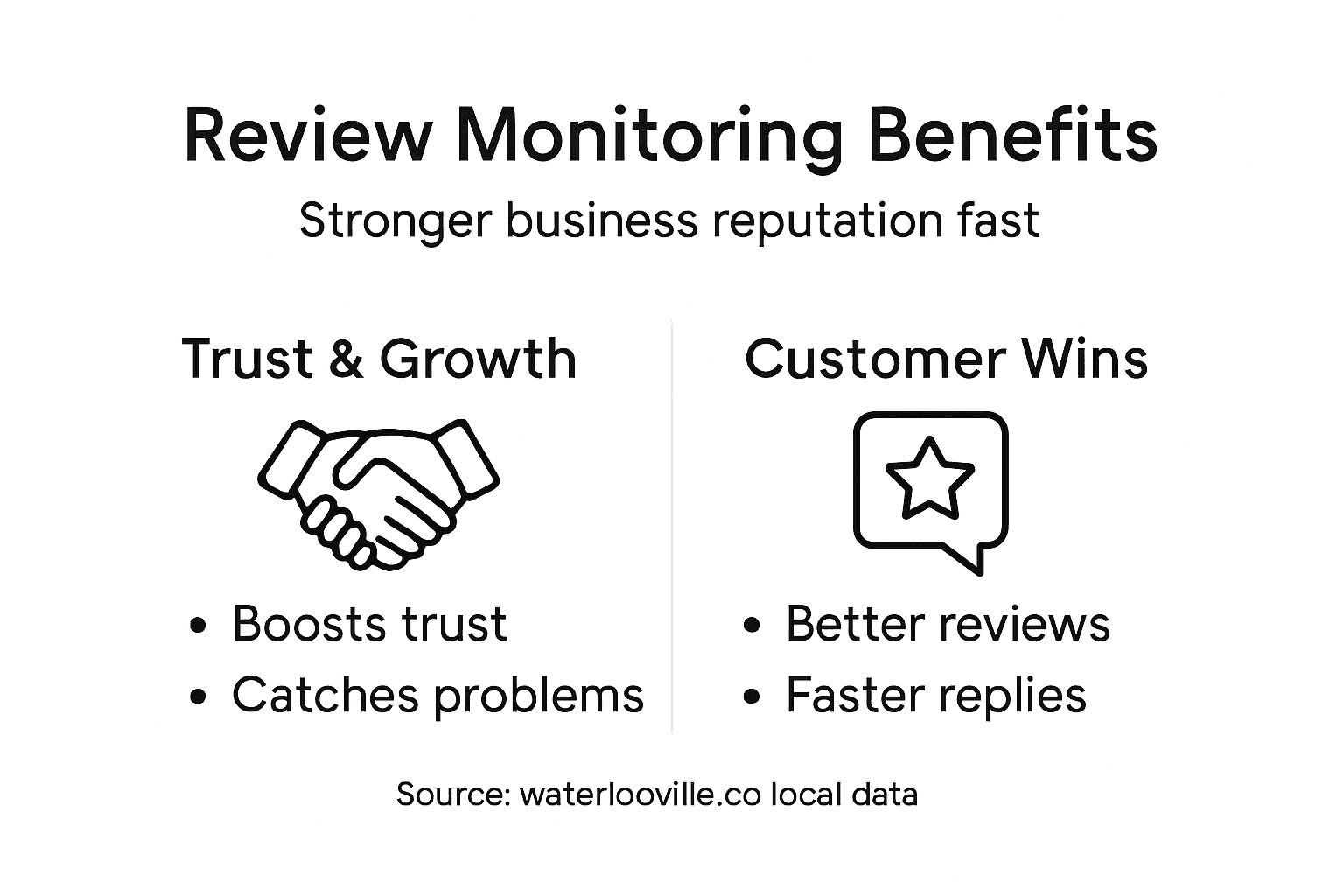
Active review monitoring transforms your business from passive to proactive. Instead of discovering a scathing one-star review weeks after it was posted, you catch it within hours and respond while the customer is still willing to engage. This speed matters tremendously in Waterlooville’s competitive local business environment. When you monitor reviews consistently, you gain insight into what customers actually think about your service, not what you assume they think. A hair salon owner might believe their pricing is fair, but if three reviews mention high prices, that is feedback worth taking seriously. A heating engineer in Denmead might think their communication is clear, but if customers repeatedly say they were left confused about what work was done, that reveals a process problem you can fix. Real-time review monitoring enables prompt feedback responses and strengthens customer relationships, creating a cycle of continuous improvement.
Catching Problems Before They Spread
Negative feedback has a shelf life. Address a complaint within 24 hours, and you often turn that dissatisfied customer into a loyal advocate who appreciates your responsiveness. Let that same complaint sit for a week, and it hardens into a permanent negative review that influences dozens of potential customers. Active monitoring means you are not playing catch-up. You spot the issue when it is fresh and emotions are still negotiable. Consider this scenario: a customer in Waterlooville has a poor experience at your restaurant and starts typing a negative review. If you are monitoring reviews actively, you might catch it while they are still in their car. A phone call saying you want to make it right can completely change the outcome. They might update their review to praise your service recovery, or they might delete it entirely. This only happens if you are watching. Passive monitoring means you discover the problem three weeks later, and by then the damage is done.
Active monitoring also reveals patterns that single reviews miss. One customer says your service was slow. Another says it was slow. A third says you were slow but friendly. Now you have a pattern: speed is an issue. This pattern insight lets you implement real changes. Maybe you need to adjust your scheduling, hire additional staff, or streamline your process. Without monitoring, you might never connect those dots because you only notice complaints when they are dramatic enough to mention to friends.
Building Stronger Customer Relationships
When you respond to reviews consistently, customers feel heard. This is not just about damage control on negative reviews. Responding to positive reviews also matters. When a customer leaves a five-star review praising your professionalism, and you publicly thank them by name and reference a specific detail from their experience, they feel valued. They are far more likely to return and recommend you to others. Active review monitoring helps maintain brand image and build stronger customer engagement, creating a community around your business rather than just a transaction list. Your customers start seeing that you care about their feedback, which builds loyalty that competitors cannot easily replicate.
This relationship building extends to customers who have not reviewed yet. When potential customers see that you consistently respond to reviews, take feedback seriously, and make improvements based on customer input, your business appears more legitimate and customer-focused. A business with 30 reviews and responses to every single one seems more professional than a business with 100 reviews and zero responses.
Competitive Advantage
In Waterlooville, most local businesses do not monitor reviews actively. They post their information on Google My Business and forget about it. The ones that do monitor have a massive advantage. They respond faster, they address concerns more thoughtfully, and they appear more engaged. When someone searches for a heating engineer in Cowplain and sees two options with similar ratings, they will almost always choose the one with visible business responses to reviews. It signals that you are active, attentive, and committed to quality. This translates directly into customer acquisition. A business known for responsive, thoughtful review management attracts customers who value communication and professionalism. You are also gathering free market research. Your customers are telling you exactly what to promote, what to fix, and what makes you different from competitors. Most of your competitors are ignoring this data completely.
See how active and passive review management compare in business outcomes:
| Management Approach | Customer Impact | SEO & Visibility | Risk Exposure |
|---|---|---|---|
| Active Monitoring | Higher loyalty, more engagement | Improved local ranking | Issues are addressed quickly |
| Passive/Neglect | Lower trust, less repeat business | Drop in search result position | Unchecked negative reviews spread |
Pro tip: Set a recurring calendar reminder to check your reviews on Google, Trustpilot, and any industry-specific platforms three times per week, so you catch new feedback within 24 hours and can respond while customers are most likely to appreciate your engagement.
Risks of Neglecting Online Reputation Management
Neglecting your online reputation is like leaving your storefront unlocked at night. You are not actively inviting trouble, but you are certainly not preventing it either. When you ignore reviews, you signal to potential customers that you do not care what they think. A prospect in Waterlooville considering your heating engineering service will notice the absence of recent reviews or unanswered feedback and assume you are either lazy or hiding something. The reality is that neglecting online reputation management causes significant credibility loss and missed business opportunities, creating a downward spiral that becomes increasingly difficult to reverse. Your competitors who actively manage their reputation will capture the customers you lose simply by doing nothing.
One of the most immediate risks is that negative reviews compound over time. A single bad review from three months ago might be forgiven if you respond thoughtfully and show improvement. But five negative reviews accumulated over a year with zero responses tell a clear story: you do not value customer satisfaction. Potential customers reading that pattern will choose your competitor every time. The damage multiplies because negative reviews hurt your search rankings. Google’s algorithm notices when reviews are old, when there are no recent additions, and when business owners never respond. Your search visibility drops, which means fewer people even see your listing. Fewer eyes on your listing means fewer leads, which means less revenue. This is not hypothetical. This happens measurably and consistently.
Lost Customer Acquisition and Revenue Impact
Your online reputation directly controls how many new customers find and choose you. A business in Cowplain with an unanswered three-star review saying “expensive and slow” will lose customers to a competitor with a 4.2-star average and visible business responses. The difference is not huge ratings. The difference is responsiveness and demonstrated commitment to improvement. When you neglect reputation management, you are essentially telling customers that you do not want their business. The revenue impact compounds quickly. If a hair salon loses just three customers per month due to poor online reputation, that is 36 customers annually. At an average spending of 50 pounds per customer visit, that is 1,800 pounds in lost annual revenue from inaction. Scale that to a heating engineer or restaurant, and the financial impact becomes devastating.
The acquisition problem extends beyond just losing sales. It affects your customer acquisition cost. A business with strong, responsive reputation management gets referrals and repeat customers at lower cost because reputation builds trust. A business neglecting reputation management has to spend more on marketing and advertising to compensate for the credibility deficit. You are paying to overcome the damage you created through inaction.
Crisis Vulnerability and Trust Erosion
When you are not monitoring your reputation actively, you are completely unprepared for a crisis. A genuine mistake happens. A customer has a legitimately bad experience. They post an angry, detailed review that contains some facts and some exaggeration. If you catch it immediately and respond with empathy and a commitment to fix it, you control the narrative. If you discover it two weeks later, the damage has spread. Other customers have read it. Potential customers have seen it and decided not to contact you. The mistake has calcified into permanent reputation damage. Neglecting reputation management increases vulnerability to reputation crises and erodes customer trust significantly, leaving you defenseless when problems occur.
Trust erosion is subtle but permanent. Trust takes years to build and moments to destroy. When customers see that you ignore feedback, that you do not respond to concerns, that you do not seem to care about their experience, they lose confidence in your professionalism. This erosion affects not just future customers but also current ones. A customer who leaves a complaint and receives no response will tell others about that poor treatment. They become an active detractor, spreading negative word-of-mouth. Meanwhile, a customer whose complaint you address promptly and sincerely often becomes your most loyal advocate. They recommend you specifically because you proved you care about getting things right.
The Compounding Effect
The insidious part of reputation neglect is that the damage compounds. Bad reviews drive down your search ranking. Lower rankings mean fewer potential customers see you. Fewer customers seeing you means fewer opportunities to generate positive reviews. Fewer positive reviews means your ranking drops further. You enter a downward cycle that requires significant effort to reverse. A business that has been neglecting reputation for two years might need six months of active, consistent review monitoring and response to recover to a competitive position. Meanwhile, competitors who stayed diligent are steadily improving.
Ignoring online reviews is not neutral. It is active harm to your business. Your Waterlooville market is competitive. Customers have choices. The businesses that deserve those choices are the ones demonstrating they value customer feedback and continuous improvement. Neglect signals the opposite.
Pro tip: Document your current review count and average rating across all platforms today, then set a quarterly reminder to track these metrics and identify any downward trends before they become crisis-level reputation damage.
Protect and Grow Your Waterlooville Business Reputation Today
Understanding the impact of online reviews on local businesses is essential to winning customer trust and staying visible in search results. This article highlights the challenge many Waterlooville businesses face: negative or neglected reviews can lower your search ranking, erode trust, and cost you valuable customers in areas like Cowplain, Denmead, and Purbrook. You need real-time insight into customer feedback and a clear strategy to respond promptly and authentically. Failing to monitor reviews actively risks allowing damaging opinions to take hold unnoticed.

Take control of your business reputation by leveraging the power of local community platforms. At Waterlooville.co, we connect you with a broad audience actively seeking trusted local services, from hair salons to heating engineers. Our site supports your efforts by featuring up-to-date reviews, ratings, and detailed business profiles that increase your credibility and search visibility. Start monitoring your online reputation now to secure competitive advantage, build lasting customer relationships, and drive more enquiries. Visit Waterlooville.co and empower your business with tools and exposure designed specifically for our community.
Frequently Asked Questions
Why is it important to monitor online reviews for my business?
Monitoring online reviews is crucial as it impacts your local business reputation. Active review management helps you address customer feedback promptly, improve services, and build trust with potential customers.
How can online reviews affect my business’s search engine ranking?
Online reviews significantly influence your business’s SEO. Factors like the volume, recency, and consistency of reviews affect your local search visibility. A business with numerous recent positive reviews will rank higher than one with fewer or older reviews.
What are the risks of neglecting my business’s online reputation?
Neglecting your online reputation risks losing customer trust and potential sales. Negative reviews can compound over time, leading to a declining search ranking and missed revenue opportunities due to perceived indifference to customer satisfaction.
How should I respond to negative reviews effectively?
Respond to negative reviews promptly and professionally. Acknowledge the issue, express empathy, and outline how you intend to resolve the situation. This approach shows potential customers that you care about feedback and are committed to improvement.
Recommended
- Waterlooville Estate Agents League Table 2024 | Compare Reviews & Ratings | Waterlooville.co
- Blog - Waterlooville News, Tips & Community Stories | Waterlooville.co
- Editorial Articles | Waterlooville Directory | Waterlooville.co
- 7 Essential Near Me Digital Marketing Agency Picks for 2026 - Aim Set Win