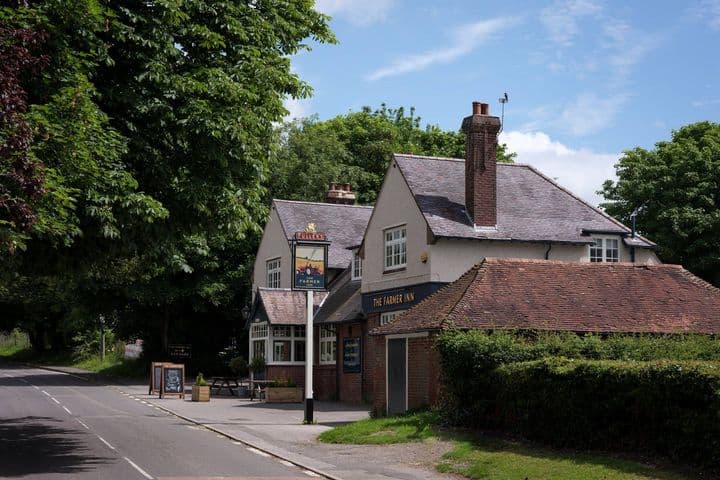
Bramdean: 5 things you didn't know about the Hampshire village
A stone circle that isn't ancient, a church built of corrugated iron, a school with a famous resident and a Roman floor that survives only in paintings.
Bramdean's stone circle by the A272 is not ancient. It is a Victorian folly, reputedly built by Colonel George Greenwood of Brockwood Park in memory of a favourite horse, though sources disagree and some credit his son William. The village name means broom valley, from a 932 charter.
Bramdean is a Hampshire village on the A272 between Winchester and Petersfield, and the stone circle beside that road is not ancient. It is a Victorian folly. Reputedly it was built by Colonel George Greenwood (1799-1875) of Brockwood Park, said to be in memory of his favourite horse. That is the short version, and even it comes with a caveat, which we explain below. Here are five things worth knowing about the village.
The stone circle by the A272
The circle is described by Wikipedia as a 19th-century addition to the Brockwood Park estate, put up in the mid-1800s by Colonel Greenwood in memory of a horse. The Megalithic Portal says much the same: reputed to have been built by the colonel, reportedly for a favourite horse, and modern rather than prehistoric.
Sources disagree on the details. The Historic England photo record and the parish council say a son, William, erected the circle, so who actually built it is disputed. Accounts also give the horse several different names, so we have not picked one. What nearly every source agrees on is that this is not Stonehenge. It is a landscape curiosity that now sits beside a busy road.
The name means broom valley
According to Wikipedia, Bramdean is first recorded as Bromdene in a 932 Anglo-Saxon charter of West Meon, and means a valley where broom grows. The parish Village Design Statement agrees on the meaning, describing the "village of the broom" with valley sides once covered in broom bushes. The charter spelling comes from Wikipedia alone, but the broom-and-valley meaning is given by two sources.
The Church in the Wood
On Bramdean Common stands a church made of corrugated iron. Wikipedia says it was built in 1883 by the Reverend Alfred Caesar Bishop for the farm workers, and that it took five weeks to construct. Be aware that other pages, including a Find a Grave entry, say five days. The two Wikipedia pages we checked say five weeks, so that is the figure we use. Either way, it went up quickly.
A school with a famous resident
Brockwood Park is the mansion at the heart of the old estate. It became a school in 1969, inspired by the philosopher Jiddu Krishnamurti, who lived there and gave open talks at the school until 1985, according to Wikipedia.
The church that stands apart, and a lost village
The parish church of St Simon and St Jude sits away from the village. Wikipedia says the original medieval settlement was probably abandoned, and that a local legend places it in a field by the Fox Inn. No thorough excavation has confirmed this. That claim rests on a single source, so treat the lost village as legend.
The Roman floor that survives in watercolours
A Roman villa at Bramdean was found in 1823, after surface finds of tiles. It is a Scheduled Monument. Historic England schedules the site, and a 2005 article by Witts describes a courtyard villa about 74 metres by 38 metres. One room in the north wing held a mosaic of the Days of the Week, and another floor showed Hercules and Antaeus.
A cover building went up within a year, but the mosaics had already been damaged by rain and what one account calls "the mischievous fingers of indiscriminate visitors". By the late 1800s the patterns were lost, partly through unskilled removal, and only fragments remain at Winchester City Museum. We know the floors from original watercolours by John Lickman and from plates in Duthy's Sketches of Hampshire (1839). Fair warning: the detailed account comes mainly from one scholarly article, backed by Wikipedia on the 1823 discovery.
Visiting
The circle can be seen from the A272, though it is overgrown. Check access and opening arrangements before visiting the church or the school grounds, as we have not verified them.
Follow Waterlooville.co on Facebook for a new local story every day.
Share this article