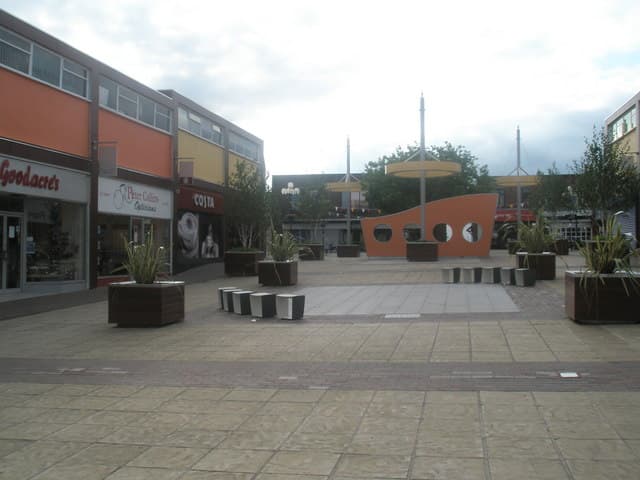
Why is Cowplain called Cowplain? The Spotted Cow story
A village with no cow, a pub that may have named it, a tram depot that served a whole railway line and a girl from the local school who went on to coach the USA to two World Cups.
Cowplain is believed to take its name from the Spotted Cow pub, built around 1860. In 1810 the area was Forest of Bere with a single brick kiln, and the village grew up where the pub stood. The pub origin is the commonly told story rather than something we can prove from a document.
If you have lived in Cowplain for any length of time, you have probably never asked where the cow went. It is a fair question. The answer to the bigger one, why the village is called Cowplain at all, is that it is believed to be named after a pub.
The short answer
According to Wikipedia, the village grew up where the Spotted Cow pub was built, around 1860, and the name is believed to come from the pub. That wording matters. This is the story as it is usually told, and we have not found a document that settles it, so treat it as the best-supported explanation rather than a proven fact. As for what happened to the actual cow, nobody seems to have written that down.
Cowplain in 1810: one brick kiln
It is hard to picture now, but in 1810 there was almost nothing here. The area sat inside the Forest of Bere, and the only building was a brick kiln. A local-history timeline adds that by 1910 Cowplain was still a hamlet, with an inn and a general shop. That is one source, but it fits the pub story neatly: the village grew round the inn.
Waterlooville was named after a pub too
Our reel makes the point with a shrug: Waterlooville takes its name from a pub (the Heroes of Waterloo, which dates from 1815) and Cowplain is believed to be named after one as well. As the reel puts it, we have a type.
The tram depot for the whole line
From 1903 to 1935 the Portsdown and Horndean Light Railway ran its trams through this part of Hampshire, and the depot for the entire line was at Cowplain. It was a three-road shed. After the trams stopped in 1935 it was used by the commercial vehicles company Foden. Wikipedia says it was requisitioned in the Second World War as a torpedo store, and a local blog also mentions a torpedo depot on the site. We should be upfront that the torpedo detail rests on those two sources, not an official record. The shed was demolished and the site redeveloped in the 1960s.
The girl from Padnell Junior who coached two World Cups
Jill Ellis went to Padnell Junior and Cowplain School. She went on to coach the United States women's team to two Women's World Cups. Not bad for a village that started with a kiln and a pub.
Why there is a Hart Plain next door
The Hart Plain ward of Waterlooville, next to The Cowplain School, is named after Hart Plain House, which once stood on the site now occupied by Waterlooville Health Centre. Sources disagree on when the estate was sold (the dates given are 1900, 1901 and 1910), so we will not pick one. The keeper's cottage, Hart Plain Lodge, still stands.
D-Day on the doorstep
Shortly before D-Day, Queen's Inclosure at Padnell and Cowplain held two army marshalling camps, known as A5 and A6. The D-Day Story records that between them they could hold 3,000 men and 430 vehicles. A 1944 war diary places the 1st Battalion South Lancashire Regiment at A5, Cowplain, but another document names a different unit, so the units clearly varied and we will not name one.
Golf and Messy Church
Two more surprises. Waterlooville Golf Club is actually in Cowplain, on Cherry Tree Avenue. It was founded in 1907 and, according to Golf Empire, redesigned in 1976 by three-time Open champion Sir Henry Cotton. And Messy Church, the all-ages church movement, began in 2004 at St Wilfrid's in Cowplain. The Messy Church directory lists more than 1,800 of them in over 30 countries.
Watch the reel
Watch it on the Waterlooville.co Facebook page, and follow us there for a new local history story every day.
Share this article